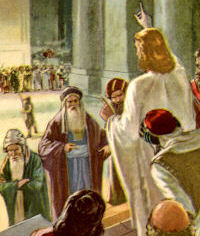
There is a shocking turnaround in today's Gospel. The people with whom Jesus grew up were assembled in the Nazareth synagogue. After they heard him read Sacred Scripture and give a one sentence homily "Today this Scripture has been fulfilled in your hearing" St. Luke tells us that "all spoke well of him and were AMAZED at the gracious words that came from his mouth." But that amazement soon turned into doubt and then into fury. — Fr. Roger J. Landry
The feasts of St. Blaise and St. Ansgar, which are ordinarily celebrated today, are superseded by the Sunday liturgy.
---
Sunday Readings
The first reading is taken from the book of Jeremiah (Jer 1:4-5, 17-19). Jeremiah is the second of the four great prophets of Israel; a contemporary of Zephaniah, Nahum, and Habakkuk. He was born in the last part of the reign of Manasseh, about 645 years before the birth of Jesus and almost a century after Isaiah. Today's reading comes from the prologue which gives an account of Jeremiah's calling. It is a dialog between Yahweh and Jeremiah.
The second reading, taken from the first letter of Paul to the Corinthians (1 Cor 12:31-13:13), continues last week's comparison of the Church to the human body. Each part of the body is no greater than any other part; rather, all work together to serve the common good. The second reading also discusses the gifts of the Holy Spirit.
The Gospel reading is taken from St. Luke (Lk 4:21-30). This rejection of Jesus by his own townfolk must have sincerely grieved him. But it was only the beginning of similar rejections. Their attempt to murder him was an indication of what was yet to come. "To his own he came but his own did not accept him" as St. John says (1:11). The reason was that the Messiah they were looking for was a political leader who would make Israel a political power not only among the nations but over the other nations. Nearly all the messianic prophecies had references to the universality of the messianic kingdom–this universality they interpreted in a political, worldly sense. Their interest in things spiritual was then at a very low ebb and therefore the message of Christ had little interest for them. They did not want a spiritual kingdom.
For seventeen centuries they had been God's Chosen People, and they were proud of their superiority over the sinful Gentiles who did not know the true God. That very pride of theirs was their undoing. The Gentiles were God's children too, and they also were to share in the new kingdom which the Messiah would establish, but the very thought of this was abhorrent to the vast majority of the Jews.
In spite of all their opposition, however, Jesus spent his public life amongst them. He gave them the first offer of entering the new kingdom. They could still continue to be God's Chosen People together with, and alongside, the other nations of the earth. They refused. And their refusal went so far as to call in the aid of the hated Gentiles to crucify the One—their own fellow Jew—who had come to bring them the message of the true kingdom and the offer of being its first citizens.
There were exceptions, of course, and honorable exceptions at that. Christ founded his Church, the new kingdom of God on the Apostles, who were Jews, and through their noble sacrifices and efforts, the kingdom spread to all the Gentile nations of the earth. Because of their sacrifices, we are Christians, members of Christ's kingdom on earth and heirs to his eternal kingdom in heaven. Through our Christian teaching we have learned that our life on this earth is but a period of preparation, a period during which we can earn the true life as citizens of his eternal kingdom. How often do we, like the Jews of Christ's day, forget this and bend all our efforts to building for ourselves a kingdom of power or wealth in this world, a kingdom which we will have to leave so soon?
We would not, of course, openly deny Christ, much less try, like his neighbors in Nazareth, to throw him to his death over a cliff: but how often in our private actions, and in our dealings with our neighbors, do we push him and his doctrine quietly aside and act as if we knew him not. In this we are no better than Christ's neighbors of Nazareth and we grieve his loving heart as much as they did on that sad day. Am I one of those (each one of us can ask himself)? Do I really love Christ or, to put it in a more personal way, do I really love myself ? If I do, I will not risk losing my place in the eternal kingdom for the sake of some paltry pleasure or gain in this present life which will end for me so very soon.
Excerpted from The Sunday Readings by Fr. Kevin O'Sullivan, O.F.M.
Things to Do:
- Read or reread Pope John Paul II's Apostolic Letter, Dies Domini on Keeping the Lord's Day Holy
✠✠✠
MASS OF THE EXTRAORDINARY FORM OF THE ROMAN RITE
Fourth Sunday after Epiphany
Introitus
Ps 96:7-8
Adoráte Deum, omnes Angeli eius: audívit, et lætáta est Sion: et exsultavérunt fíliæ Iudæ.
Ps 96:1
Dóminus regnávit, exsúltet terra: læténtur ínsulæ multæ.
V. Glória Patri, et Fílio, et Spirítui Sancto.
R. Sicut erat in princípio, et nunc, et semper, et in saecula saeculórum. Amen
Adoráte Deum, omnes Angeli eius: audívit, et lætáta est Sion: et exsultavérunt fíliæ Iudæ.
Dicutur Gloria
|
Introit
Ps 96:7-8
Adore God, all you His angels: Sion hears and is glad, and the cities of Juda rejoice.
Ps 96:1
The Lord is King; let the earth rejoice; let the many isles be glad.
V. Glory be to the Father, and to the Son, and to the Holy Ghost.
R. As it was in the beginning, is now, and ever shall be, world without end. Amen.
Adore God, all you His angels: Sion hears and is glad, and the cities of Juda rejoice.
|
Oratio
Orémus.
Deus, qui nos, in tantis perículis constitútos, pro humána scis fragilitáte non posse subsístere: da nobis salútem mentis et córporis; ut ea, quæ pro peccátis nostris pátimur, te adiuvánte vincámus.
Per Dominum nostrum Iesum Christum, Filium tuum: qui tecum vivit et regnat in unitate Spiritus Sancti Deus, per omnia saecula saeculorum.
R. Amen.
|
Collect
Let us pray.
O God, You Who know that our human frailty cannot stand fast against the great dangers that beset us, grant us health of mind and body, that with your help we may overcome what we suffer on account of our sins.
Through Jesus Christ, thy Son our Lord, Who liveth and reigneth with thee, in the unity of the Holy Ghost, ever one God, world without end.
R. Amen.
|
Lectio
Léctio Epístolæ beáti Pauli Apóstoli ad Romános.
Rom 13:8-10
Fratres: Némini quidquam debeátis, nisi ut ínvicem diligátis: qui enim díligit próximum, legem implévit. Nam: Non adulterábis, Non occídes, Non furáberis, Non falsum testimónium dices, Non concupísces: et si quod est áliud mandátum, in hoc verbo instaurátur: Díliges próximum tuum sicut teípsum. Diléctio próximi malum non operátur. Plenitúdo ergo legis est diléctio.
R. Deo gratias.
|
Lesson
Lesson from the letter of St. Paul the Apostle to the Romans
Rom 13:8-10
Brethren: Owe no man anything except to love one another; for he who loves his neighbor has fulfilled the Law. For You shall not commit adultery. You shall not kill. You shall not steal. You shall not bear false witness. You shall not covet; and if there is any other commandment, it is summed up in this saying, You shall love your neighbor as yourself. Love does no evil to a neighbor. Love therefore is the fulfillment of the Law.
R. Thanks be to God.
|
Graduale
Ps 101:16-17
Timébunt gentes nomen tuum, Dómine, et omnes reges terræ glóriam tuam.
V. Quóniam ædificávit Dóminus Sion, et vidébitur in maiestáte sua. Allelúia, allelúia.
Ps 96:1
Dóminus regnávit, exsúltet terra: læténtur ínsulæ multæ. Allelúia.
|
Gradual
Ps 101:16-17
The nations shall revere Your name, O Lord, and all the kings of the earth Your glory.
V. For the Lord has rebuilt Sion, and He shall appear in His glory. Alleluia, alleluia.
Ps 96:1
The Lord is King; let the earth rejoice; let the many isles be glad. Alleluia.
|
Evangelium
Sequéntia ✠︎ sancti Evangélii secúndum Matthǽum.
R. Gloria tibi, Domine!
Matt 8:23-27
In illo témpore: Ascendénte Iesu in navículam, secúti sunt eum discípuli eius: et ecce, motus magnus factus est in mari, ita ut navícula operirétur flúctibus, ipse vero dormiébat. Et accessérunt ad eum discípuli eius, et suscitavérunt eum, dicéntes: Dómine, salva nos, perímus. Et dicit eis Iesus: Quid tímidi estis, módicæ fídei? Tunc surgens, imperávit ventis et mari, et facta est tranquíllitas magna. Porro hómines miráti sunt, dicéntes: Qualis est hic, quia venti et mare obœ́diunt ei?
R. Laus tibi, Christe!
Dicutur Credo
|
Gospel
Continuation ✠︎ of the Holy Gospel according to St. Matthew
R. Glory be to Thee, O Lord.
Matt 8:23-27
At that time, Jesus got into a boat, and His disciples followed Him. And behold, there arose a great storm on the sea, so that the boat was covered by the waves; but He was asleep. So they came and woke Him, saying, Lord, save us! we are perishing! But He said to them, Why are you fearful, O you of little faith? Then He arose and rebuked the wind and the sea, and there came a great calm. And the men marvelled, saying, What manner of Man is this, that even the wind and the sea obey Him?
R. Praise be to Thee, O Christ.
Credo is said
|
Offertorium
Ps 117:16; 117:17
Déxtera Dómini fecit virtutem, déxtera Dómini exaltávit me: non móriar, sed vivam, et narrábo ópera Dómini.
|
Offertory
Ps 117:16-17
The right hand of the Lord has struck with power: the right hand of the Lord has exalted me; I shall not die, but live, and declare the works of the Lord.
|
Secreta
Concéde, quǽsumus, omnípotens Deus: ut huius sacrifícii munus oblátum fragilitátem nostram ab omni malo purget semper et múniat.
Per Dominum nostrum Iesum Christum, Filium tuum: qui tecum vivit et regnat in unitate Spiritus Sancti Deus, per omnia saecula saeculorum.
R. Amen.
|
Secret
Grant, we beseech You, almighty God, that the offering of this sacrifice may always cleanse and strengthen the weakness of our nature.
Through Jesus Christ, thy Son our Lord, Who liveth and reigneth with thee, in the unity of the Holy Ghost, ever one God, world without end.
R. Amen.
|
Prefatio
V. Dóminus vobíscum.
R. Et cum spíritu tuo.
V. Sursum corda.
R. Habémus ad Dóminum.
V. Grátias agámus Dómino, Deo nostro.
R. Dignum et iustum est.
de sanctissima Trinitate
Vere dignum et iustum est, æquum et salutáre, nos tibi semper et ubíque grátias ágere: Dómine sancte, Pater omnípotens, ætérne Deus: Qui cum unigénito Fílio tuo et Spíritu Sancto unus es Deus, unus es Dóminus: non in unius singularitáte persónæ, sed in uníus Trinitáte substántiæ. Quod enim de tua glória, revelánte te, crédimus, hoc de Fílio tuo, hoc de Spíritu Sancto sine differéntia discretiónis sentímus. Ut in confessióne veræ sempiternǽque Deitátis, et in persónis propríetas, et in esséntia únitas, et in maiestáte adorétur æquálitas. Quam laudant Angeli atque Archángeli, Chérubim quoque ac Séraphim: qui non cessant clamáre cotídie, una voce dicéntes:
Sanctus, Sanctus, Sanctus Dóminus, Deus Sábaoth. Pleni sunt coeli et terra glória tua. Hosánna in excélsis. Benedíctus, qui venit in nómine Dómini. Hosánna in excélsis.
|
Preface
P. The Lord be with you.
S. And with thy spirit.
P. Lift up your hearts.
S. We have lifted them up to the Lord.
P. Let us give thanks to the Lord our God.
S. It is meet and just.
Holy Trinity
It is truly meet and just, right and for our salvation, that we should at all times, and in all places, give thanks unto Thee, O holy Lord, Father almighty, everlasting God; Who, together with Thine only-begotten Son, and the Holy Ghost, art one God, one Lord: not in the oneness of a single Person, but in the Trinity of one substance. For what we believe by Thy revelation of Thy glory, the same do we believe of Thy Son, the same of the Holy Ghost, without difference or separation. So that in confessing the true and everlasting Godhead, distinction in persons, unity in essence, and equality in majesty may be adored. Which the Angels and Archangels, the Cherubim also and Seraphim do praise: who cease not daily to cry out, with one voice saying:
Holy, Holy, Holy, Lord God of Hosts! Heaven and earth are full of Thy glory! Hosanna in the highest! Blessed is He that cometh in the Name of the Lord! Hosanna in the highest!
|
Communio
Luc 4:22
Mirabántur omnes de his, quæ procedébant de ore Dei.
|
Communion
Luke 4:22
All marvelled at the words that came from the mouth of God.
|
Postcommunio
Orémus.
Múnera tua nos, Deus, a delectatiónibus terrenis expédiant: et cœléstibus semper instáurent aliméntis.
Per Dominum nostrum Iesum Christum, Filium tuum: qui tecum vivit et regnat in unitate Spiritus Sancti Deus, per omnia saecula saeculorum.
R. Amen.
|
Postcommunion
Let us pray.
May Your gifts, O God, free us from the attraction of earthly pleasures and give us new strength through Your heavenly nourishment.
Through Jesus Christ, thy Son our Lord, Who liveth and reigneth with thee, in the unity of the Holy Ghost, ever one God, world without end.
R. Amen.
|
Commentary for the Readings in the Extraordinary Form:
Fourth Sunday after Epiphany
"'Why are you fearful, O you of little faith?' Then He arose and rebuked the wind and the sea, and there came a great calm" (Gospel).
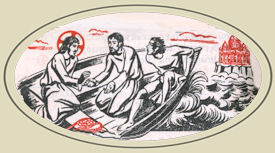
This is a picture of both the human and the Divine in Jesus and in His Church (symbolized by the dome of St. Peter's at the right). Jesus, a tired Man, fell off to sleep during "a great storm." Jesus, the tireless, wide-awake God, "arose," as it were from the tomb of a dead sleep, to restore "a great calm."
Enemies of the Church are ever ready to gloat over our human "weakness" (Prayer, Secret), tossed about by the "waves" of human passion, by the "winds" of inhuman evil spirits.
The Divine Presence is within our baptized, absolved souls. Let us rise up "from the facination of earthly things" (Postcommunion).
— Excerpted from My Sunday Missal, Confraternity of the Precious Blood
